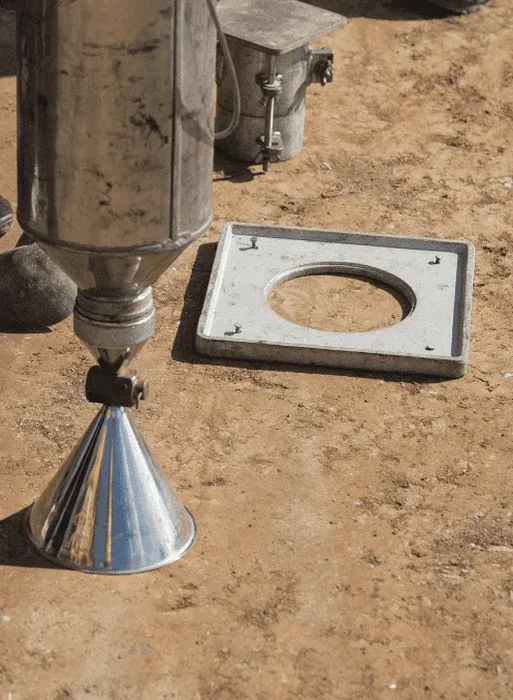
Sacramento sits at the confluence of the American and Sacramento Rivers, and much of the metro area is built on recent alluvial deposits that demand rigorous compaction verification. The sand cone test provides a direct measure of in-place density, and our crews run it daily on levee improvements in Natomas, warehouse pads in South Sacramento, and roadway subgrades through the Central Valley. We follow ASTM D1556 and D698, calibrating sand and cones before each shift because the silty fine sands around the Delta can change optimum moisture by two percentage points between morning and afternoon. For projects where the sand cone isn’t practical below 12 inches, we pair it with a nuclear gauge correlation or deeper SPT drilling to tie surface density to the bearing layers beneath the fill.
A single failed density test on a levee lift can hold up 2,000 cubic yards of placement—we turn results in under 45 minutes so the spread keeps moving.
Scope of work in Sacramento
Risks and considerations in Sacramento
Sacramento’s floodplain history—from the Gold Rush-era raised streets to modern FEMA levee accreditation—means density shortcuts get caught. A soft layer 18 inches down that wasn’t tested because the cone only goes 8 inches becomes a long-term settlement problem on a tilt-wall warehouse. We’ve seen projects in the Natomas Basin where differential settlement exceeded 3 inches in two years because fill placed during a wet winter wasn’t checked at the right moisture window. The regulatory environment here is tight: Central Valley Flood Protection Board specs and local building departments require density logs before foundation placement. Skipping a test or accepting a marginal number without a re-roll can trigger a stop-work order that costs more in downtime than the entire testing budget.
Our services
Our field density group in Sacramento handles everything from a single test on a residential footing to full-time QA on 200-acre solar farms. The equipment is calibrated daily, the sand is dried and graded, and the crew chief on site has at least five years of earthwork testing in the Central Valley.
Compaction acceptance testing
Routine sand cone tests per lift on structural fill, backfill behind retaining walls, and utility trench backfill, with results plotted against project compaction curves within one hour.
Correlation with nuclear gauges
We run side-by-side sand cone and nuclear density tests to build project-specific correlations for faster daily QA once the relationship is approved by the geotechnical engineer.
Troubleshooting failed areas
When a lift fails, we run a quick moisture check and help the grading contractor dial in roller passes or aeration time to bring the material within spec without over-processing.
Quick answers
How much does a sand cone density test cost on a Sacramento project?
For a single mobilization, a field density test with the sand cone method typically runs between US$100 and US$140 per test when part of a larger earthwork QA program. The exact rate depends on the number of tests per day, travel distance, and whether we’re also running companion Proctor curves in the lab. A standalone call-out for just one test will carry a minimum charge that covers crew time and equipment calibration.
When is the sand cone method required instead of a nuclear gauge?
The sand cone method becomes the referee test when nuclear gauge results are borderline, when the soil contains aggregate larger than 1.5 inches that throws off the gauge calibration, or when the specification explicitly requires ASTM D1556. On Sacramento levee work and many public-works jobs, the spec mandates a certain percentage of sand cone tests even if a gauge is used for production testing.
How deep can you test with the sand cone method?
A standard sand cone test typically evaluates the top 6 to 12 inches of a compacted lift. If the spec requires density verification at greater depth, we excavate to the target elevation, trim a level surface, and run the test at that depth. For density checks deeper than about 3 feet, we often recommend pairing the sand cone with test pits to visually log the fill profile and run density samples at multiple horizons.