Sacramento’s grid didn’t happen by accident. When the city raised its streets by nearly ten feet in the 1860s to escape flooding from the Sacramento and American Rivers, nobody was thinking about California Bearing Ratio. But that century-old fill—mixed with the silty loam and clay of the Central Valley—is exactly what pavement engineers wrestle with today. A laboratory CBR test on a remolded sample tells you what the soaked subgrade will actually do under traffic loading, which matters more here than in many drier parts of the state. Whether you’re extending a subdivision out by the Delta or repaving a warehouse lot near the old railyards, the flexible pavement design hinges on a CBR value that reflects real moisture conditions, not just a dry-weather guess.
A soaked CBR under 3% in Sacramento’s finer soils isn’t a pavement failure—it’s a design parameter that tells you exactly how much aggregate base to add before laying asphalt.
Scope of work in Sacramento
Risks and considerations in Sacramento
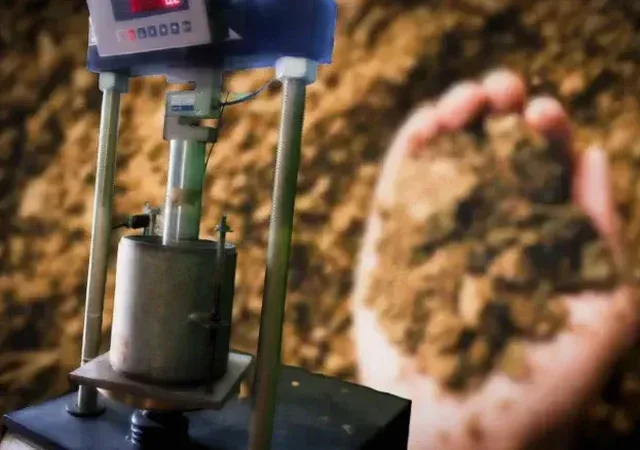
We run the CBR test on a motorized load frame with a calibrated 10,000-pound ring dynamometer—the same setup you’d find in Caltrans district materials labs. The piston advances at a fixed rate while the dial gauges track penetration and load simultaneously. In Sacramento’s warmer months, the lab air conditioner runs hard to keep the soaking tank at a stable 70°F, because temperature swings in the water bath affect the viscosity of the pore fluid and can shift the penetration curve by a couple tenths of a percent. If the CBR comes back below 3% after soaking, Caltrans standard plans call for removal and replacement of the upper two feet of subgrade or a thicker aggregate base section. Ignoring that number, or skipping the soak, puts the pavement at risk of early fatigue cracking and rutting—problems we’ve documented on older arterials where the design assumed a CBR value that just wasn’t there once the winter rains settled in.
Our services
Our Sacramento lab handles the full CBR workflow from sample receipt to signed report, and we coordinate directly with the drilling crew when undisturbed sampling is part of the scope.
Soaked Laboratory CBR
Full ASTM D1883 procedure with 96-hour submersion at modified Proctor density. Includes moisture-density relationship, swell measurement during soaking, and corrected CBR at 0.1 in and 0.2 in penetration.
CBR with Companion Classification
Paired package that runs the CBR alongside Atterberg limits and a washed sieve analysis per ASTM D2487. Gives the pavement designer both the strength number and the USCS classification needed for Caltrans submittals.
Field CBR Correlation
For larger projects we run parallel laboratory CBR and in-place density tests to build a site-specific correlation curve, letting the contractor track compaction quality without waiting for lab turnarounds.
Quick answers
What does a laboratory CBR test cost in Sacramento?
A single-point soaked CBR test, including the moisture-density relationship, typically runs between US$120 and US$240 depending on whether companion classification tests are bundled. Three-point CBR curves for design-phase studies are at the upper end of that range per point.
Do Sacramento projects always need a soaked CBR, or is the unsoaked value enough?
Caltrans and most city-county public works specs in the Sacramento region require the soaked value. The shallow groundwater in areas like the Natomas basin and the seasonal saturation of clay-rich soils make the unsoaked CBR misleading for long-term pavement performance—the soaked number is the one that governs the structural section.
How long does the lab CBR test take from sample to report?
The soaking period alone is four days minimum per ASTM D1883, so a standard single-point CBR report is ready in five to six working days after the sample arrives at the lab. Expedited schedules are possible if we run the compaction curve in parallel with the soak, but the 96-hour submersion can’t be shortened without violating the standard.