We see it repeatedly on Sacramento job sites: a contractor assumes the sandy loam near the American River will drain like the finer silts down in the Pocket neighborhood, and suddenly the excavation plan falls apart. Grain size distribution governs almost everything—permeability, frost susceptibility, compaction behavior, and even seismic response. Without a complete sieve and hydrometer analysis per ASTM D2487, you are guessing at the soil's engineering personality. Our team runs the full curve, from the 75 mm sieve down to the 2-micron clay fraction, using calibrated equipment traceable to NIST standards. When we combine that with an understanding of local alluvial deposits from the Sacramento and American river systems, the classification becomes a reliable design input rather than a box to check. For sites with questionable bearing layers, we often pair grain size analysis with SPT drilling to correlate gradation with blow counts and confirm the stratigraphy before foundation design proceeds.
If you only run the sieve and skip the hydrometer, you are blind to the 15-30% fines that control permeability and compressibility in Sacramento basin soils.
Scope of work in Sacramento
Risks and considerations in Sacramento
Sacramento sits at an elevation of roughly 30 feet above sea level, on deep Quaternary alluvium that ranges from gravelly channel deposits to fat clays in the basin troughs. A grain size misclassification here does not stay theoretical—it becomes a flooded excavation, a failed infiltration basin, or a shear strength assumption that unravels during the next moderate earthquake on the nearby faults. The 2014 South Napa earthquake, while centered 50 miles west, sent enough energy through Sacramento's soft soils to remind engineers that amplification is real and particle size controls liquefaction susceptibility directly. When we classify a soil as SP (poorly-graded sand) versus SM (silty sand), the difference in seismic settlement potential can be the difference between an acceptable performance level and a repair bill that wipes out the contingency. Our lab runs the full hydrometer because skipping it in this basin is a gamble on fines content, and the odds are not in your favor.
Our services
Our Sacramento grain size testing integrates into broader geotechnical characterization workflows. Whether you need a single classification or a full soil suite, we keep turnaround tight and documentation thorough.
Sieve Analysis (Coarse Fraction)
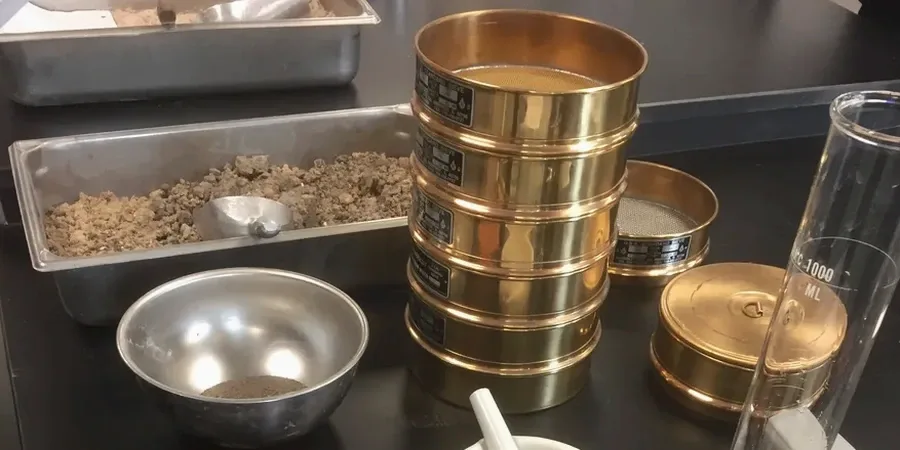
Mechanical sieving from 75 mm to No. 200 mesh, with wash-sieve procedure to accurately separate fines. Includes gradation curve, Cu and Cc coefficients, and USCS classification per ASTM D2487. Typical for aggregate base, concrete sand, and filter media qualification.
Hydrometer Analysis (Fine Fraction)
Sedimentation testing of minus No. 200 material with ASTM 152H hydrometer, temperature-corrected and dispersant-calibrated. Resolves silt and clay fractions down to 2 microns. Essential for compressibility and permeability predictions in Sacramento basin clays.
Combined Sieve and Hydrometer Package
Full particle size distribution from gravel to clay, delivered as a single semilog curve. Includes D10, D30, D60, uniformity coefficient, coefficient of curvature, and dual USCS/AASHTO classification. The standard package for foundation and earthwork design.
Specialized Sedimentation Studies
Extended hydrometer runs for highly plastic clays, parallel testing for quality control, and correlation studies linking particle size to Atterberg limits or permeability. We tailor the protocol when standard durations do not capture the full clay tail.
Quick answers
What does a grain size analysis cost in Sacramento?
For a standard combined sieve and hydrometer test, budget between US$110 and US$170 per sample. Sieve-only runs fall at the lower end, while full hydrometer packages with extended readings are at the upper end. Volume discounts apply for five or more samples from the same project.
When is the hydrometer test required instead of just a sieve analysis?
Any time visual classification suggests more than 12 percent passing the No. 200 sieve, ASTM D2487 requires hydrometer testing for a complete USCS classification. Sacramento basin soils frequently hit that threshold, especially in the Pocket, Greenhaven, and Natomas areas where silts and clays are common. Skipping it leaves you with an incomplete classification and uncertain drainage assumptions.
How long does a full grain size analysis take?
A combined sieve and hydrometer test typically takes three to five working days from sample receipt. The hydrometer phase alone requires a minimum of 24 hours of sedimentation readings, plus temperature correction and curve computation. We can expedite to two days when project schedules demand it, with advance coordination.
What sample size do you need for the test?
We need roughly 500 grams of dry material for a sand-dominant sample, and about 200 grams for fine-grained silts and clays. The sample should be representative and undisturbed if possible, though disturbed samples from SPT splits or auger cuttings work for grain size. Bring it in a sealed bag labeled with boring ID and depth.