Sacramento's rapid expansion from Gold Rush trading post to California's capital left a legacy of hydraulic mining debris and floodplain deposits that challenge modern construction. The city sits at the confluence of the American and Sacramento Rivers, where loose alluvial sands and silts dominate the subsurface profile. For projects built on these compressible deposits, vibrocompaction design becomes the primary tool for mitigating settlement and liquefaction risk. Our design team maps the lateral extent of loose zones using CPT testing and grain size analysis, then specifies vibrator frequency, probe spacing, and target penetration depth to achieve 70% relative density or better. The approach respects Sacramento's groundwater table, which often sits within 10 feet of grade, requiring careful lift sequencing and drainage control during execution.
Targeting 70% relative density in Sacramento's floodplain sands requires energy calibration against CPT tip resistance — not just grid assumptions.
Scope of work in Sacramento
Risks and considerations in Sacramento
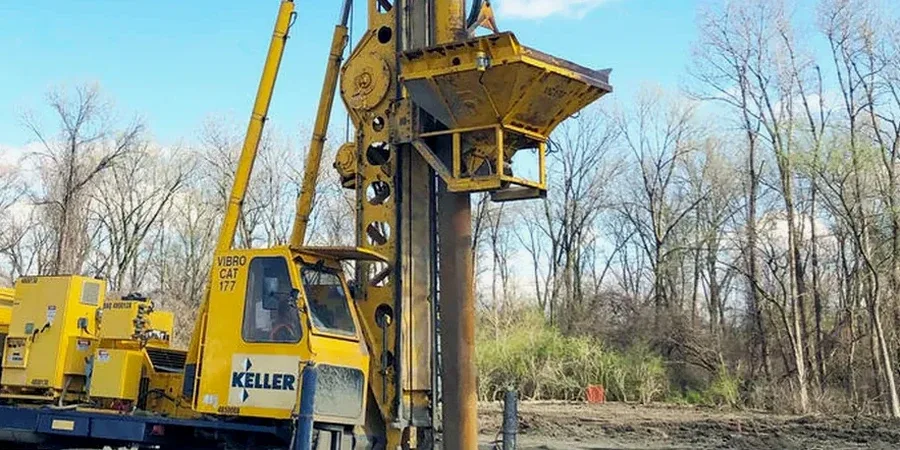
A six-story mixed-use project on Richards Boulevard encountered 22 feet of loose hydraulic mining tailings — sand with less than 35% relative density — during pre-construction borings. Without deep densification, the structure faced over 4 inches of differential settlement and a factor of safety against liquefaction below 0.8 under the MCE ground motion. The vibrocompaction design specified a staggered grid with 7-foot spacing and a two-pass sequence: initial penetration to 30 feet at full water flush, followed by a second pass to densify the upper 15 feet with stone backfill. Post-treatment CPT soundings confirmed tip resistance increased from 40 to over 110 tsf across the treatment zone. The improvement let the structural engineer use shallow spread footings instead of deep piles, cutting foundation costs substantially while meeting the city's stringent peer review requirements for seismic hazard zones.
Our services
Our vibrocompaction design services in Sacramento cover the full project lifecycle, from feasibility assessment through construction quality assurance. Each scope is calibrated to the specific basin stratigraphy encountered on site.
Liquefaction Mitigation Design
Site-specific densification plans targeting loose saturated sands below the groundwater table in Sacramento's seismic hazard zones, with post-treatment verification protocols.
Settlement Control Under Footings
Grid-based vibrocompaction design for low to mid-rise structures on compressible floodplain fills, reducing total and differential settlement to acceptable limits for shallow foundations.
Pre-Construction Feasibility Analysis
Desktop review of existing geotechnical data, CPT correlations, and grain size curves to determine whether vibrocompaction is suitable for the target soil profile and depth.
Construction QC and Verification Testing
On-site monitoring of vibrator energy, penetration rate, and amperage during execution, plus post-densification CPT or SPT verification at specified probe locations.
Quick answers
What soil types in Sacramento respond best to vibrocompaction?
Clean sands and gravelly sands with less than 12–15% fines content densify most effectively. Sacramento's floodplain deposits — particularly the loose alluvial sands along the American River corridor and the hydraulic mining tailings in the central basin — show excellent response. Silty sands with 15–25% fines require careful field trials and may need a reduced grid spacing. Cohesive soils and thick organic layers do not densify under vibration and require alternative ground improvement methods such as stone columns or surcharge with wick drains.
How long does vibrocompaction design and execution take for a typical Sacramento project?
Design typically takes 10 to 15 business days after receiving the geotechnical investigation report and site survey. The design phase includes liquefaction triggering analysis per ASCE 7, vibrocompaction grid layout, energy calibration curves, and a quality control plan. Field execution for a 20,000-square-foot site usually runs 7 to 14 days depending on depth and access constraints. Post-treatment verification testing adds 2 to 3 days. The entire process from design approval to final report generally spans 4 to 6 weeks.
What is the typical cost range for vibrocompaction design in the Sacramento area?
Design fees for a single building pad or commercial lot in Sacramento typically range from US$1,590 to US$5,850, depending on project size, number of treatment zones, and verification testing requirements. Larger multi-building developments or projects requiring extensive liquefaction analysis fall toward the upper end. This fee covers the densification plan, energy specifications, construction oversight protocol, and final compliance report. The vibrocompaction execution itself is contracted separately through specialty ground improvement contractors.
Does vibrocompaction eliminate the need for deep foundations in Sacramento's seismic zones?
In many cases, yes — particularly for low to mid-rise structures on loose granular soils. By increasing relative density above 70%, vibrocompaction can raise the site's bearing capacity and reduce settlement to levels that allow shallow footings instead of driven piles or drilled shafts. However, the decision depends on the structural loads, the presence of thick compressible clay layers beneath the densified zone, and the seismic performance objectives. Our design includes a foundation recommendation that compares the cost and schedule of shallow foundations on improved ground versus deep foundation alternatives.