We have seen too many projects in Sacramento where the foundation design is treated as an afterthought. A standard shallow footing plan gets dropped onto a site near the Sacramento River, and within a few years, differential settlement starts cracking walls. The culprit is almost always the same: ignoring the deep, compressible alluvial clays and silts that define the Central Valley floor. A proper pile foundation design bypasses these weak surficial layers entirely, transferring structural loads down to competent bearing strata. Our approach integrates local borehole data with seismic refraction surveys to map the depth to bedrock, ensuring the pile tip elevation is based on real subsurface geometry rather than generalized assumptions. For dense urban infill projects in Midtown, we often combine this with CPT testing to get a continuous strength profile before selecting the pile type and capacity.
In the Sacramento Valley, the difference between a successful deep foundation and a structural failure often lies in correctly predicting the depth to the Pleistocene-age Riverbank Formation.
Scope of work in Sacramento
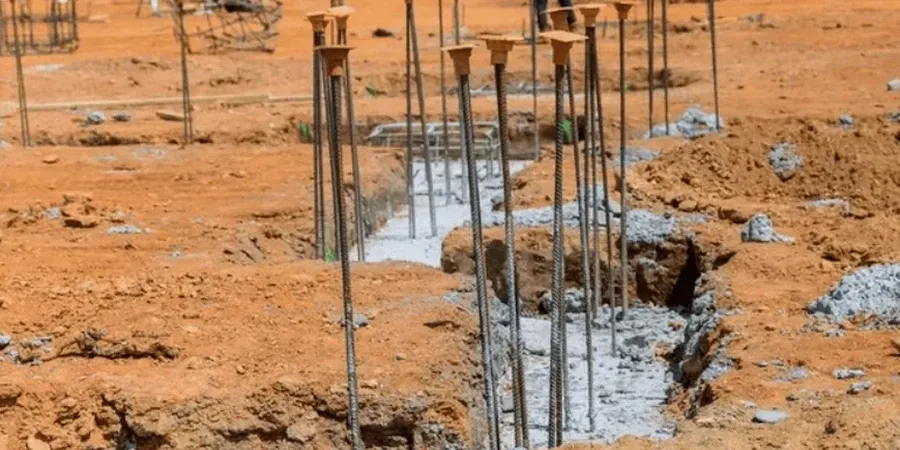
Risks and considerations in Sacramento
Sacramento sits at the northern edge of the Great Valley, where hot, dry summers bake the clay near the surface, causing significant desiccation cracking. Then winter atmospheric rivers arrive, and the same clays swell dramatically as the water table rises to within a few feet of grade. This annual shrink-swell cycle can literally jack shallow footings out of the ground. A pile foundation design accounts for this by anchoring the structure below the active moisture zone, but we must also account for the drag force (downdrag) created when the settling upper soil clings to the pile shaft. Our calculations include a neutral plane analysis to determine where this negative skin friction transitions to positive resistance. Additionally, the Sacramento-San Joaquin Delta region to the south presents some of the highest seismic hazard in the state due to deep basin amplification effects. Our team applies site-specific response spectra to ensure that the pile-to-cap connection detailing can withstand the ductility demands imposed by a major seismic event on the nearby Coast Range faults.
Our services
Our Sacramento office provides a full spectrum of deep foundation engineering, from initial feasibility studies through construction inspection. We tailor each scope to the specific challenges of your site within the Central Valley.
Pile Capacity Analysis
Static and dynamic analysis of driven and drilled piles, including side friction and end-bearing calculations calibrated to local CPT and SPT data.
Liquefaction & Lateral Spread Assessment
Evaluation of cyclic stress ratios and lateral displacement potential for deep foundations in Sacramento's floodplains. Includes downdrag and kinematic loading from lateral spreading.
Pile Load Test Program Design
Development of high-strain dynamic (PDA) and static load test specifications to verify design assumptions and optimize pile lengths.
Deep Foundation Inspection
Full-time observation during pile installation, including driven pile blow count verification and drilled shaft base cleanliness inspection per Caltrans and IBC standards.
Quick answers
How deep do piles typically need to go in Sacramento?
It varies significantly even within a single neighborhood. In the downtown core, we often find the competent Riverbank Formation gravels at 35 to 50 feet below grade. However, moving east into the higher terraces, refusal can be shallower, while in the Natomas Basin we have designed piles extending to 70 feet to bypass thick sequences of recent alluvium and organic silts. A site-specific boring is the only way to know for sure.
What is the cost range for a pile foundation design package?
For a typical commercial or multi-family residential project in the Sacramento area, the engineering fee for a complete pile foundation design package generally falls between US$1,930 and US$6,620. The scope includes the geotechnical analysis, foundation recommendations, pile schedule, and construction specifications. More complex sites requiring dynamic load testing oversight or 3D lateral analysis will be at the higher end of that range.
Does the high groundwater in Sacramento affect pile design?
Absolutely. Groundwater is commonly encountered just 5 to 10 feet below the surface. For cast-in-drilled-hole piles, we have to consider slurry displacement or temporary casing to maintain shaft stability during construction. The buoyant unit weight of the soil below the water table also reduces the effective stress, which directly impacts our skin friction calculations.
How do you account for seismic risk in pile foundations here?
We follow the ASCE 7-22 provisions for Seismic Design Category D, which covers most of Sacramento County. This includes a kinematic interaction analysis to determine how the pile deforms under earthquake shaking. We check the pile structural capacity for combined axial and bending demands at the interface between soft clay and stiff bearing layers, where demand is often highest. Liquefaction-induced loss of lateral support is also explicitly modeled.
Can you design piles for residential additions or light-frame construction?
Yes, we frequently design deep foundations for residential work in Sacramento, especially for second-story additions where existing footings are suspect or for new construction on marginal soil. For lighter loads, helical piles or small-diameter micropiles often provide a cost-effective solution that minimizes excavation and concrete usage while still reaching competent bearing soil.